17-02
⋮⋮ Program
- Writing non-fiction
- Reading non-fiction
- Rhetorical tools
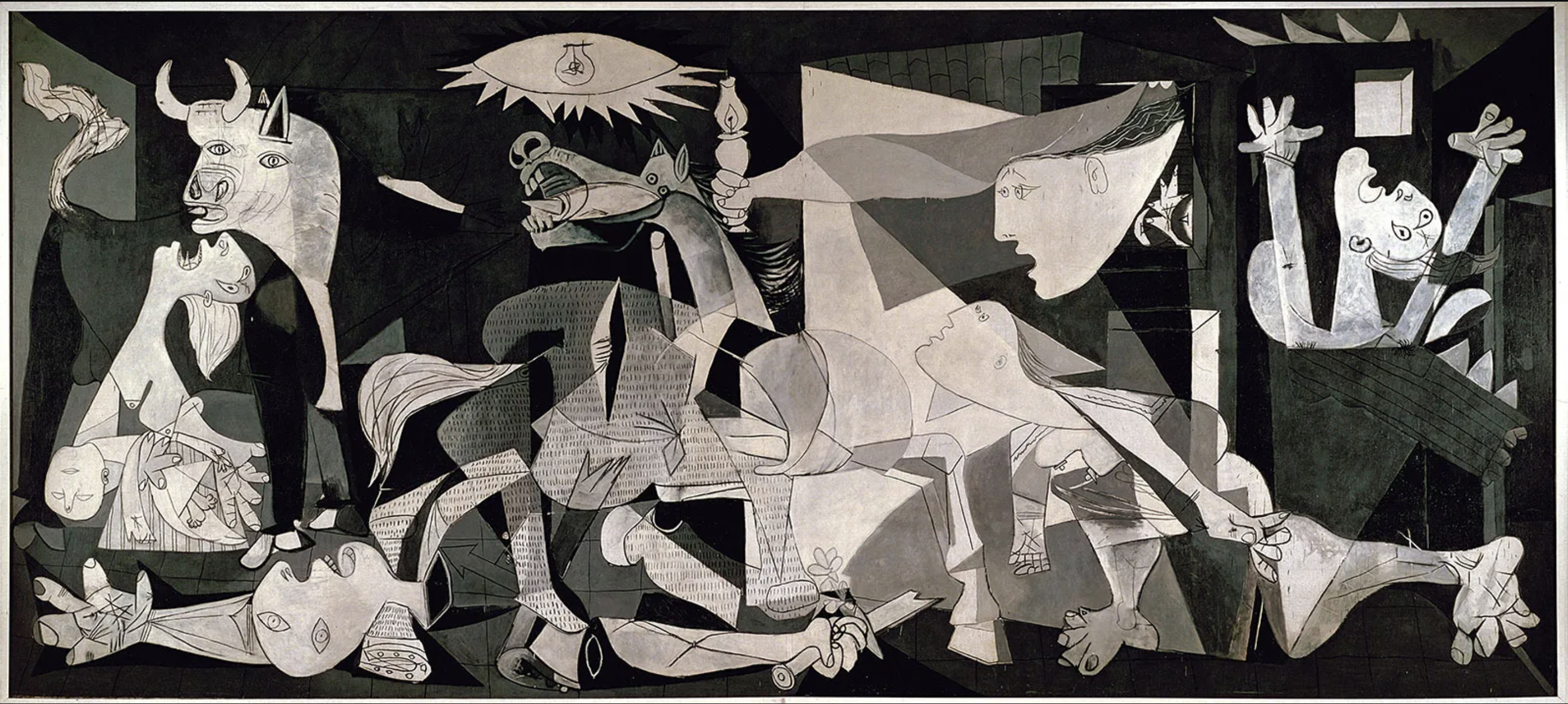
Pablo Picasso, Guernica (1937).
≣ Tasks
Writing non-fiction
- Find information about Christ church or the UN.
- Write a speech based on your research.
- Give your speech to your partner.
New Zealand Prime Minister Adresses UN General Assembly (2019)
Reading non-fiction
- Read the rest of the speech.
- Find four quotations that stand out as impactful or well-written.
Rhetorical tools
To sound convincing and eloquent, a speaker can use rhetorical devices:
alliteration: repetition of consonant sounds at the beginning of nearby words.anaphora: repetition of one or more words at the beginning of successive clauses.antithesis: contrasting opposite words or ideas.assonance: repetition of vowel sounds in nearby words.metaphor: a concrete image used figuratively.personification: giving human qualities to non-human things.repetition: repeating words or phrases for emphasis.simile: comparing unlike things using “like” or “as”.rule of three: listing three related elements in sequence.
Rhetorical tools
A speaker can also use modes of persuasion:
pathos: appeal to emotion.logos: appeal to reason, evidence, and logic.ethos: appeal to trust, authority, and credibility.
Rhetorical tools
- Choose a section of about 25 lines.
- Find examples of rhetorical tools in that section.
Reflection
- Review your quotations.
- Write a quick reflection on what makes a good speech.
- If it is not rhetorical tools, explain what else you think matters.